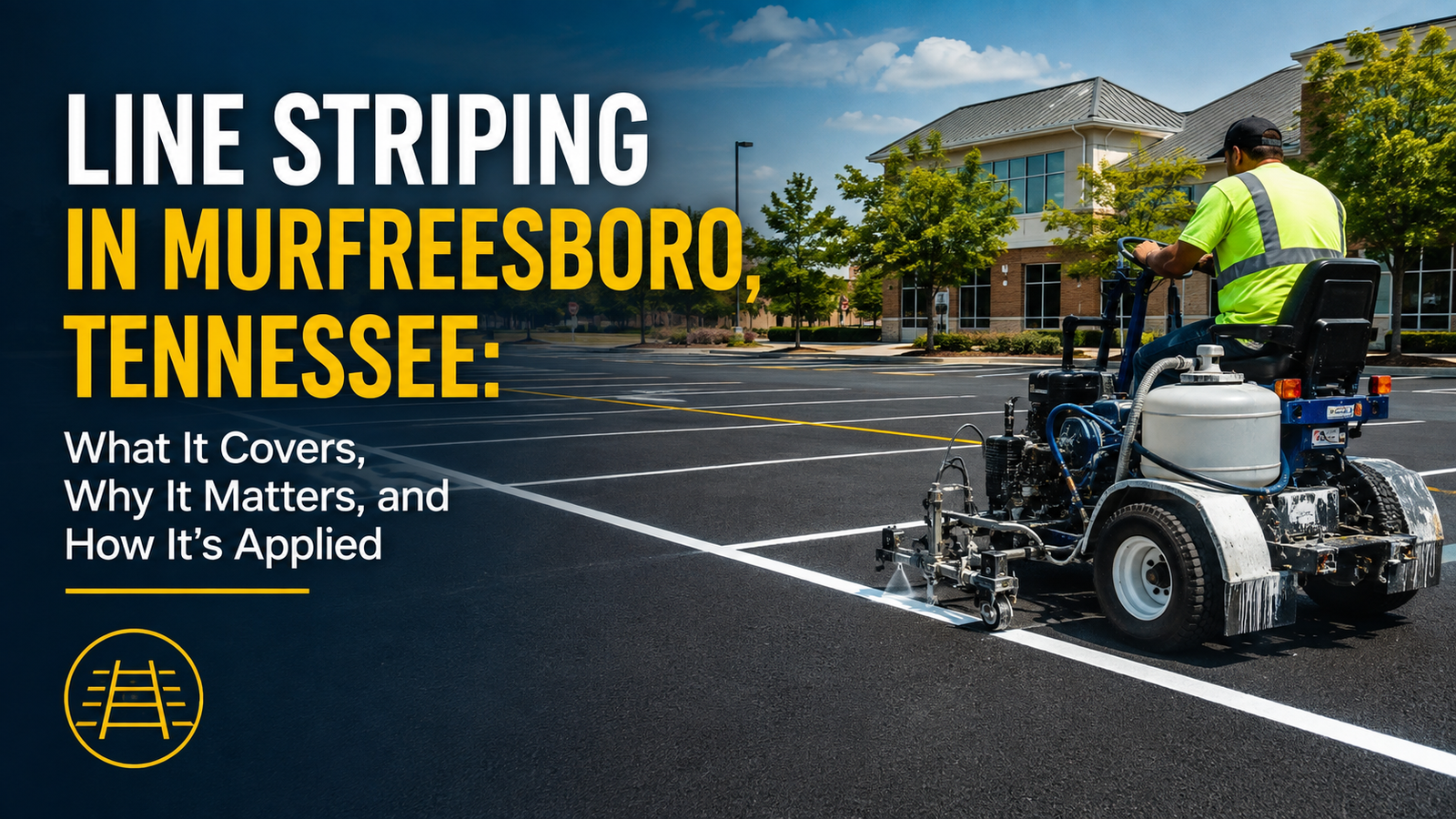
Line striping also called pavement marking, traffic line painting, or simply striping is the application of painted lines and symbols on paved surfaces to organize traffic flow, define use zones, communicate regulatory requirements, and protect pedestrian and vehicle safety. In Murfreesboro, Tennessee, line striping is a critical element of functional property management for commercial businesses, industrial facilities, schools, healthcare campuses, apartment complexes, and any other property with paved areas that must organize vehicle and pedestrian movement. This guide explains the full scope of Line Striping Murfreesboro services in Murfreesboro and why proper, visible markings are essential.
The Scope of Line Striping Beyond Parking Lots
While parking lot striping is the most visible and most commonly requested line striping application, line striping covers a much broader range of pavement marking needs in Murfreesboro’s commercial and institutional landscape.
Warehouse and industrial floor marking is a significant and growing line striping market driven by Murfreesboro’s expanding logistics and light manufacturing base. Interior concrete and asphalt floors in warehouses, distribution centers, and manufacturing facilities require lane markings that designate forklift traffic lanes, pedestrian walkways, loading dock approach paths, equipment staging areas, inventory storage zones, and safety clearance zones around machinery and emergency exits. OSHA regulations require that warehouses and industrial facilities maintain clear visual separation between vehicle and pedestrian traffic areas, and floor markings are the primary tool for achieving this separation.
School and educational campus line striping covers fire lanes, school bus loading and unloading zones, pedestrian crosswalks, and the specialized traffic management markings that address the unique safety challenges of high-volume pedestrian and vehicle interactions during school arrival and dismissal periods. Middle Tennessee State University in Murfreesboro one of the city’s dominant institutions has extensive campus road and parking facilities that require regular maintenance and re-striping.
Road and traffic control markings on private roads, apartment complex internal streets, and institutional campus roadways include centerline markings, edge lines, stop bars, yield markings, speed limit stencils, and turn lane designations. These markings manage vehicle behavior on private road networks in ways that prevent accidents and improve traffic flow.
Sports court markings for basketball courts, tennis courts, volleyball courts, pickleball courts, and multi-purpose recreational surfaces require precise line placement to meet the specific dimensional requirements of each sport. Murfreesboro’s active community recreation infrastructure and the numerous HOA-managed recreational amenities in its residential communities generate regular demand for sports court line maintenance and re-striping.
Line Striping Paint Types and Their Performance in Tennessee
Murfreesboro line striping contractors use several categories of traffic paint, each with different performance characteristics appropriate for different applications.
Water-based acrylic traffic paint is the most commonly used exterior line striping material for standard parking lot and roadway applications in Tennessee. It dries quickly (30 to 60 minutes in warm conditions), produces good initial color brightness, is environmentally favorable (low VOC), and provides adequate durability for most commercial applications. It is sensitive to temperature and humidity during application materials should not be applied below 50°F or when rain is imminent.
Oil-based traffic paint provides better initial adhesion and longer durability than water-based formulations, particularly in high-traffic applications. It is used for applications where longevity under heavy traffic is the primary requirement, such as busy parking garage drive lanes or high-volume commercial driveways. Oil-based materials require longer dry times and have higher VOC content than water-based alternatives.
Thermoplastic traffic marking material is a heat-applied product used for highly durable, long-lasting road markings. Applied using heated extrusion or spray equipment, thermoplastic markings can last five to seven years or more under heavy traffic conditions far longer than paint-based materials. Thermoplastic is used for crosswalk markings, stop bars, and other markings where durability justifies the higher application cost. It is less common in standard parking lots than in road and drive aisle applications.
Reflective beads can be added to any of these materials to increase night visibility. Glass microbeads are dropped into the wet paint or thermoplastic material immediately after application, embedding in the surface and creating retroreflective visibility when vehicle headlights illuminate them at night. Reflective markings are particularly valuable for parking lots and driveways in Murfreesboro that are heavily used after dark.
Line Striping Scheduling in Middle Tennessee
Line striping in Murfreesboro is a year-round service, but the optimal scheduling window aligns with the sealcoating season May through October. Striping performed during warm, dry conditions achieves faster dry times, better adhesion, and longer service life than striping applied in cool, wet, or humid conditions.
When striping is being applied as part of a sealcoating project, the striping must wait until the sealcoat has fully cured typically 24 to 48 hours after application. Applying striping to uncured sealcoat results in poor adhesion and premature failure of the new markings. Professional Murfreesboro contractors coordinate the sealcoating and striping phases to ensure proper cure time between the two applications.
Common Questions About Line Striping in Murfreesboro
How long does line striping take to dry in Murfreesboro? Water-based acrylic traffic paint dries to the touch in 30 minutes and is fully ready for vehicle traffic within one hour under warm, dry Murfreesboro conditions. Cooler or more humid conditions extend these times. Newly painted areas should be protected with cones until paint is dry to prevent vehicle contact.
Can line striping be applied over an existing faded stripe? Yes. Striping directly over existing faded markings is common in re-striping projects. The new stripe is applied in the same position as the old one, restoring brightness and visibility. If the layout is being changed, existing markings that will be abandoned may need to be blacked out with an opaque coating before new markings are applied to avoid driver confusion.
What is the minimum visibility standard for line striping? There is no single universal standard for minimum stripe visibility, but the practical standard is that markings must be clearly visible to drivers under normal daylight conditions from a reasonable approach distance. When drivers must slow or hesitate to determine where parking stalls are, the lot is due for re-striping.